
LOGISTICS AND DOCUMENTATION

Prepare shipment records without losing sight of document discrepancies
Illustrative project
Illustrative scenario. The data and calculations are assumptions used to explain the application.
Application: Logistics and documentation
Business type: Manufacturer preparing international commercial shipments
Documents that match in name but differ in content
The manufacturer coordinates orders, packing lists, commercial invoices, and transport documents. Files arrive from different teams and change when quantities or dates are adjusted. The coordinator compares references, packages, weights, and recipients while also checking which version is current.
A discrepancy can hold up the record’s review or lead to further questions. Requirements also differ by goods, route, and destination. The decision is which shipment record is ready for review by the responsible specialist and which inconsistencies must be resolved before it is shared with the next authorized participant.
A document scope defined with specialists
The solution would require orders, original documents, shipment identifiers, versions, and a requirements matrix supplied and maintained by qualified people. That matrix would distinguish transaction type, product, and destination, with an effective date and source. The project would not rely on a supposedly universal document checklist for every shipment.
The system would extract fields and compare information across files. It would check format, presence, and consistency, showing where differences occur. Where multiple languages or units of measure are involved, it would use approved equivalents. Any generated translation would be identified as an aid.
The tool would not independently determine tariff classification, regulatory compliance, customs value, or the admissibility of goods. Those decisions belong to the responsible professionals. It would not modify documents issued by third parties. Connections to the ERP, document management system, carriers, or other platforms would depend on verified permissions, interfaces, and technical restrictions.
A workflow that prepares for expert review
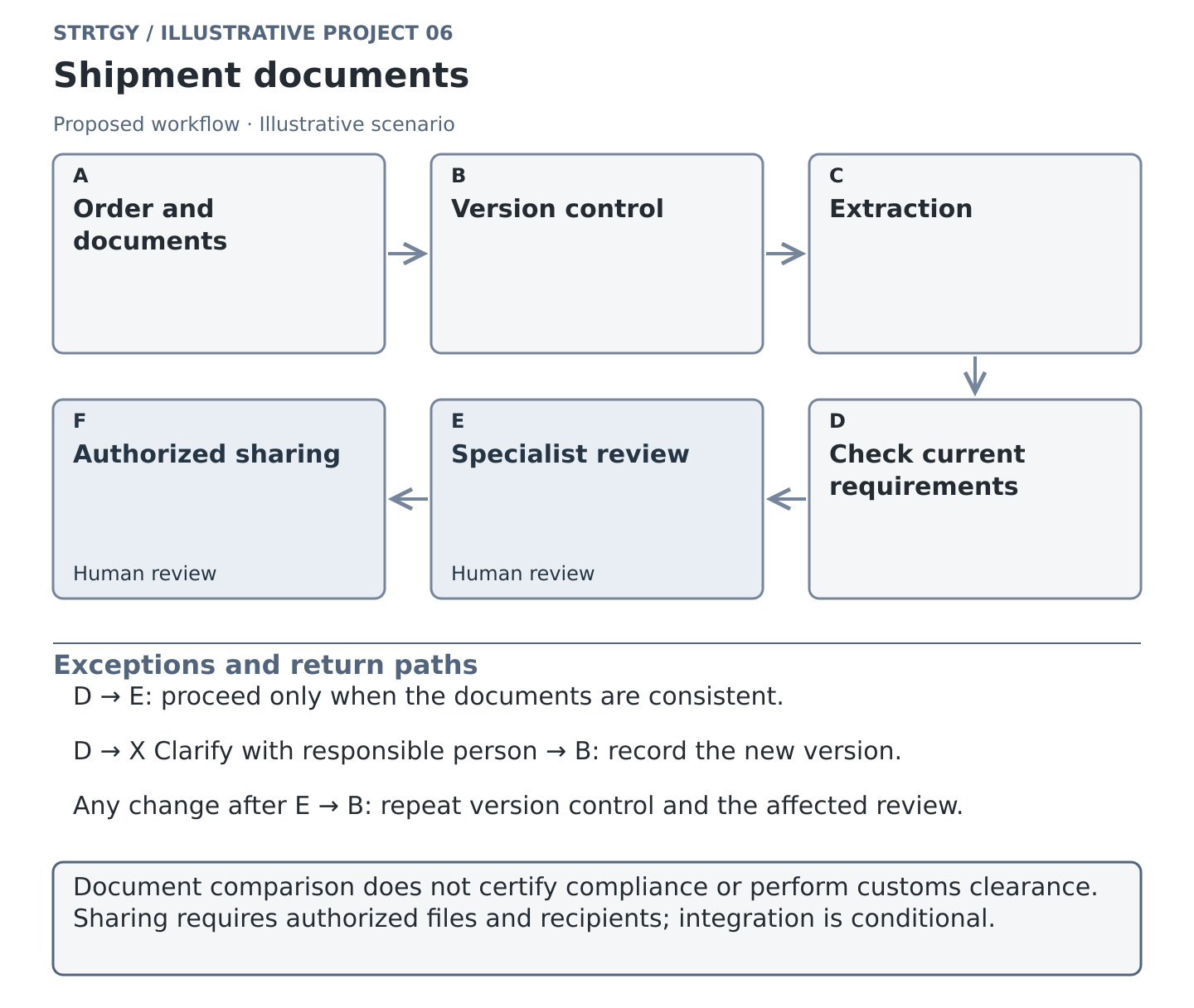
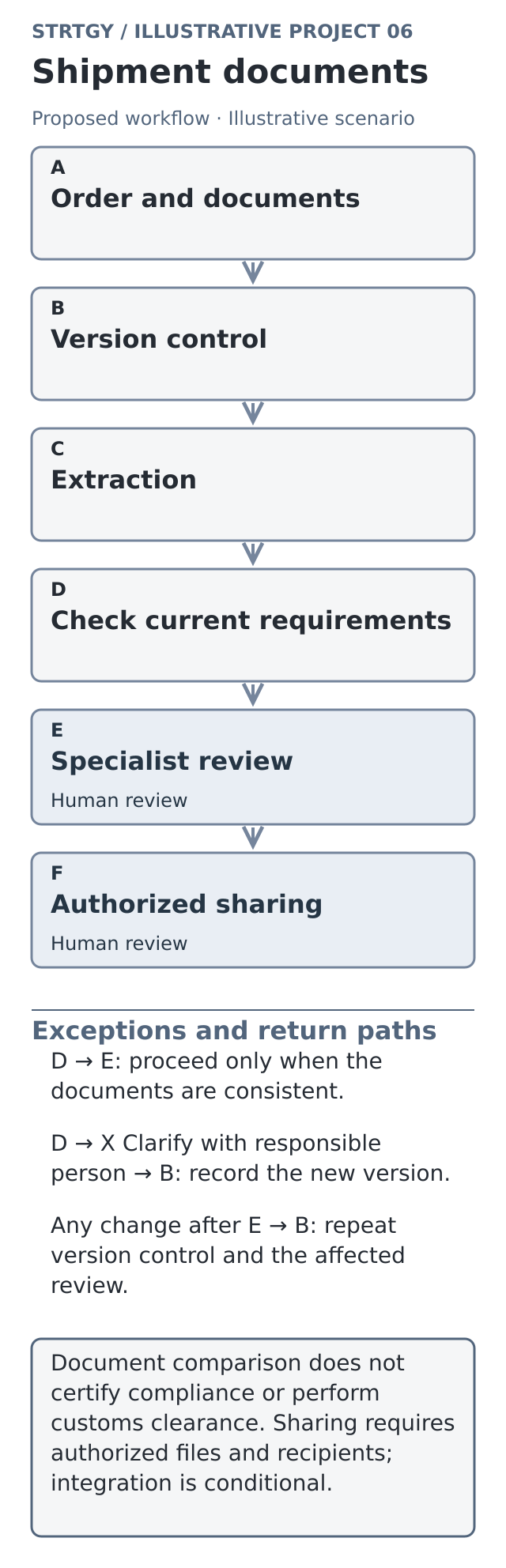
Open. The shipment record is created with its order and responsible people, restricting access by role.
Version. Documents are added while retaining originals and history. Superseded versions remain identifiable and separate from current ones.
Extract. The workflow locates references, quantities, and other defined fields. Illegible data and uncertain interpretations go to a person.
Compare. Fields are compared across documents using the current requirements matrix, with each discrepancy’s exact location shown.
Clarify. The coordinator confirms whether the discrepancy requires correction by the issuer or a documented explanation. Figures are not changed simply to force a match.
Review. The qualified specialist assesses the record and the matters outside the automated scope. Approval is recorded against the reviewed version.
Share. The responsible person authorizes the recipients and files. If integrated sending is enabled, it checks status and avoids duplicates. A later change returns the record to review.
What the coordinator would see
A view would place the order and its documents side by side, with related fields connected and differences highlighted. The user could distinguish a missing item from a discrepancy or an outstanding specialist review. Each decision would retain its owner, date, and rationale. A “documents prepared” status would not be presented as permission to transport, export, or import goods.
Deliverables would include a document catalog, approved validation matrix, extraction with source references, version control, and an exception inbox. Tests would cover late changes, incompatible units, illegible documents, and unauthorized recipients. Implementation would begin with a narrowly defined transaction type and a review of sources, followed by historical testing, parallel operation, and a supervised pilot. Expansion to other routes would require validating requirements and responsible parties. No identical timetable would be promised across contexts.

Photographic illustration of comparing documents and versions before specialist review.
How preparation and control would be evaluated
The baseline would be established by transaction type and document complexity:
Active preparation time: coordinator minutes spent organizing and comparing documents divided by records prepared.
Discrepancies detected before sending: confirmed discrepancies found before sharing divided by all confirmed discrepancies in the record × 100.
Document completeness: records meeting the current matrix divided by records reviewed × 100.
Version errors: records shared with a superseded document divided by records shared × 100.
Acceptance would require every known critical discrepancy in the tests to be flagged and later changes to invalidate affected reviews. Transit and clearance times would not be attributable to this tool alone because they depend on external parties and conditions.
An economic example limited to measurable work
Assume 120 records per month, requiring 55 minutes of active preparation per record. If a pilot established a time of 35 minutes, the difference would be 120 × 20 ÷ 60 = 40 hours per month. At an assumed internal cost of 280 MXN per hour, that would represent 11,200 MXN per month in valued capacity. These are hypothetical figures, not a promise. Estimating net value would require deducting processing, storage, specialist review, integration, and support costs. Avoided fines, transit days, or recovered revenue are not counted without verifiable evidence.
Which document discrepancies cause a shipment to be reviewed repeatedly? Let’s discuss a specific record and who needs to approve it.