
SALES AND QUOTES

Español | English
Home · What We Do · Applications · Insights · Contact
Service proposals with a scope your team can review
Illustrative project
Illustrative scenario. The data and calculations are assumptions used to explain the application.
Application: Sales and quotes
Business type: Technical maintenance services provider for commercial facilities
The cost of quoting from scattered information
The maintenance provider prepares proposals for preventive and corrective equipment maintenance. A customer might send an inventory, photographs, and a request combining activities, schedules, and access requirements. Sales reuses previous proposals, operations estimates hours and materials, and a supervisor checks what can be committed to.
When these steps do not use the same version, a proposal can omit a visit, include a service that was not requested, or assume the customer will provide tools and access. Clarifying those points later takes time and can change expected profitability. The decision is to define a scope that can be quoted, its dependencies, and the approval required before presenting it.
What the solution would need
The project would require an approved service catalog, standard activity-time matrices, current reference costs, travel rules, templates, standard exclusions, and review policies. Requests and site-visit notes would provide the evidence for each opportunity. Historical contracts could be consulted only with appropriate permissions and identifiable versions; their terms would not automatically become valid for a new buyer.
The system would organize requirements into a matrix: requested, included, excluded, or pending. A calculation engine would assemble the specified labor hours, materials, and expenses. A language component would draft the proposal from that structure, linking each important condition to its source.
Reading CRM data, querying ERP costs, or creating a proposal in the sales system would depend on available interfaces and authorized access. An initial version might need only document uploads and editable output. The solution would not certify that a job is safe or replace a technical site visit when one is required. It would neither approve legal terms nor commit resources independently.
A workflow with clear responsibilities
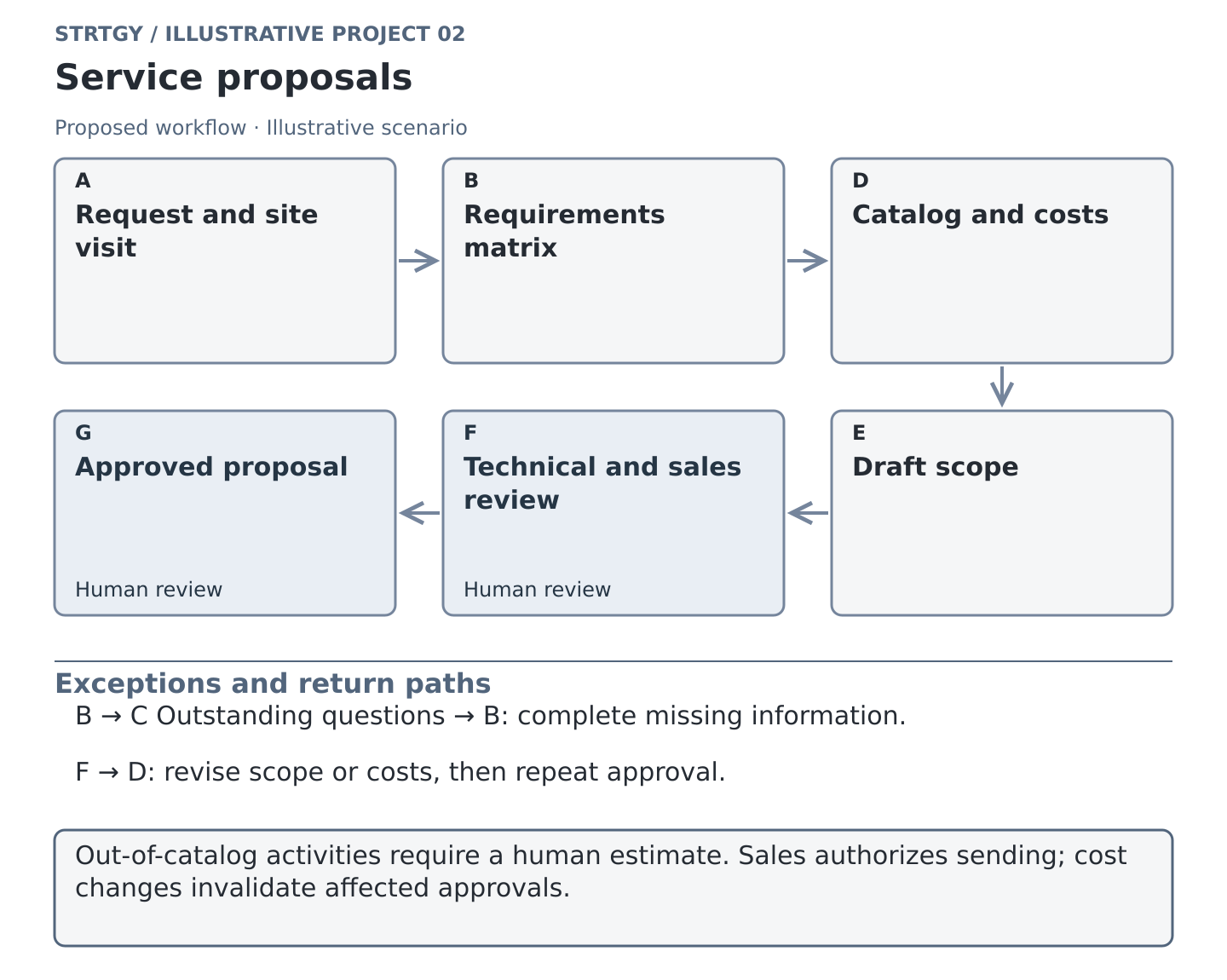
Receive. The opportunity, files, and responsible person are recorded. Versions and duplicate documents are identified.
Break down. The workflow extracts equipment, locations, frequency, and restrictions, preserving their sources. Conflicting instructions are flagged.
Clarify. It prepares questions for sales or a technical specialist rather than filling gaps with hidden assumptions.
Size the work. Activities are matched to approved services and standard times. Work outside the catalog requires a human estimate.
Calculate. A cost sheet is built with quantities, rates, and validity dates. Missing data prevents the proposal from being marked ready.
Review. Operations validates feasibility; the commercial lead reviews price and terms. Contract changes go to the appropriate team.
Prepare for delivery. A versioned proposal is generated with scope, exclusions, and validity. Sales authorizes sending and retains the final document.
The experience for sales and operations
A view for each opportunity would bring the original request, proposed scope, and outstanding questions together. Changing an activity would update the calculation and show which reviews must be repeated. The salesperson could explain a price change without searching through scattered messages between teams.
Deliverables would include the requirements matrix, a standardized catalog for the pilot scope, calculation logic, a proposal template, and approval history. Testing would cover version changes, expired costs, and requests outside the catalog. Implementation would move from a service family with sufficient data to parallel testing, team review, and controlled use. Expansion to other service families or transactional integrations would require renewed validation of rules, data quality, and permissions.

Measures and acceptance criteria
The baseline would be established before the pilot and segmented by complexity, avoiding comparisons between a simple visit and a multi-site contract:
Active time per proposal: total sales and operations minutes divided by completed proposals.
Scope completeness: requirements with an explicit decision divided by identified requirements × 100.
Internal rework: proposals reopened because of internal omissions or errors divided by proposals reviewed × 100.
Cost consistency: line items whose calculations match the approved rule divided by line items checked × 100.
Validation would check that a cost update invalidates affected approvals and that pending items do not disappear when the document is generated. Sales conversion could be tracked as an additional measure, without attributing changes exclusively to the tool.
A testable economic hypothesis
For 80 proposals per month, assume combined team effort falls from 150 to 105 minutes per proposal. Capacity released would be 80 × 45 ÷ 60 = 60 hours per month. At an assumed internal cost of 300 MXN per hour, this would represent 18,000 MXN per month in valued capacity. These figures are not committed targets. An investment case would require measuring the difference, verifying how the hours are used, and deducting the system’s incremental costs. No increase in margin or revenue, or reduction in headcount, is assumed.
Do proposals go through repeated reviews because the scope changes between teams? Let’s discuss a specific service and its approval points.