
SALES AND QUOTES

Español | English
Home · What We Do · Applications · Insights · Contact
A quote ready for review, with the information behind it
Illustrative project
Illustrative scenario. The data and calculations are assumptions used to explain the application.
Application: Sales and quotes
Business type: Distributor of industrial maintenance components
When responding means checking with four people
The distributor receives requests containing parts lists, photographs, and the codes its buyers use. The salesperson identifies equivalent items, checks stock, finds the customer’s price list, and asks about lead times. A straightforward request can stall because a code is incomplete or two files show different terms.
The business problem is specific: the team spends its attention gathering information, leaving less time to address the buyer’s needs. A quickly prepared quote can also commit to a date the warehouse has not confirmed. The decision is which line items can be quoted, on what terms, and which need clarification before they can be offered.
Information and proposed scope
The project would start with authorized requests, a master catalog with approved equivalents, current customer-specific price lists, commercial rules, available inventory, and lead times. It would also require units of measure, applicable taxes as defined by the business, and named approvers. An initial scope could use controlled ERP exports and a dedicated inbox.
The solution would extract line items, suggest matches, and assemble supporting evidence to prepare a draft. Quantity and price calculations would follow deterministic rules. AI would help interpret text and explain missing information, without inventing technical equivalents or commercial terms.
Live inventory queries, CRM record creation, and sending through corporate email would depend on integrations, permissions, and testing. Without those connections, the deliverable would be a downloadable draft showing when its sources were updated. Checking stock would not reserve goods. Any reservation capability would require an explicitly agreed additional scope.
How a request would move through the process
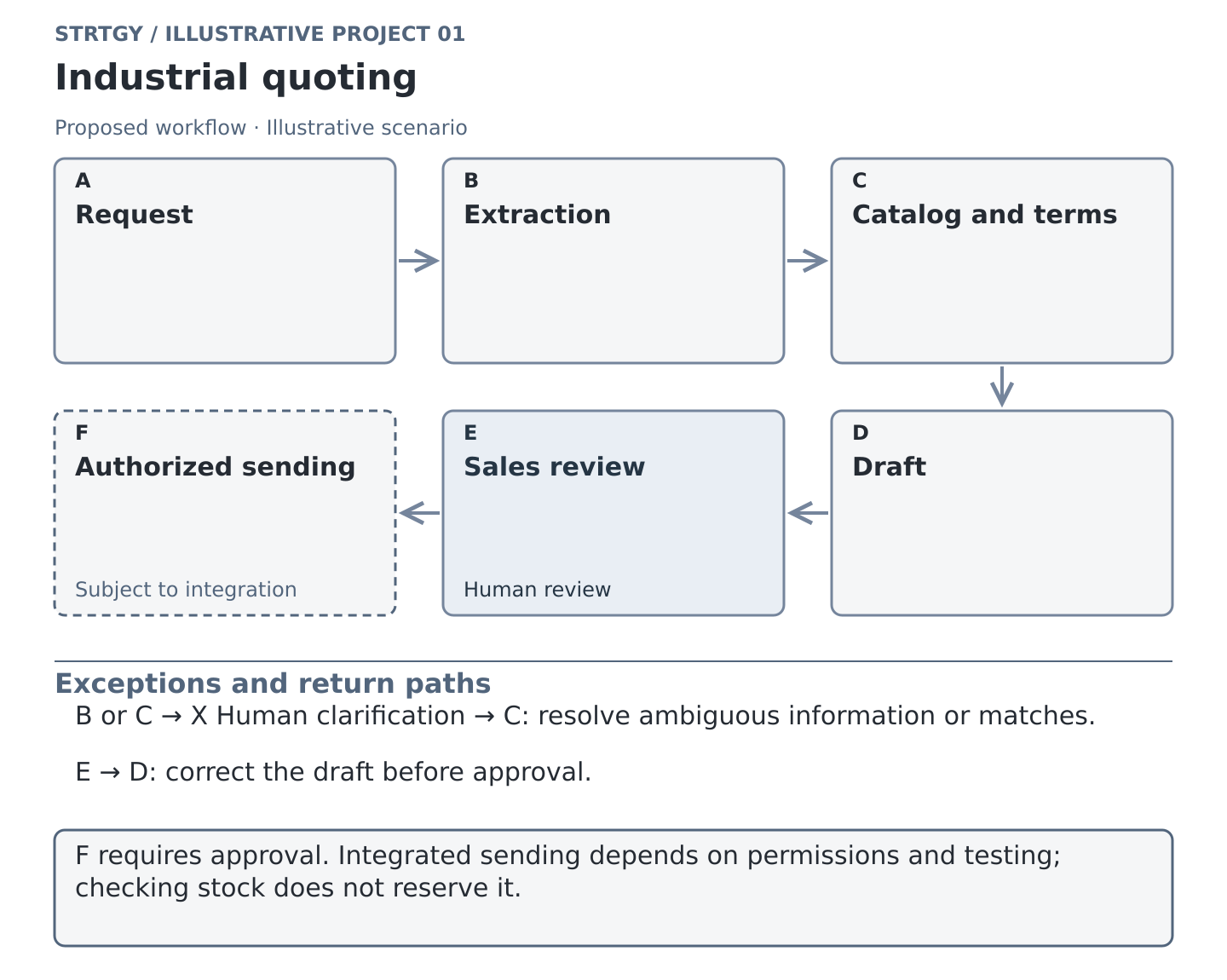
Register. The workflow assigns an identifier and preserves the original message, checking for duplicate requests before creating another record.
Interpret. It extracts products, quantities, and units, linking each item to its source passage. Illegible information goes to review.
Match. It searches for codes in the approved catalog. Ambiguous matches and technical substitutions go to a specialist.
Check. It gathers current prices, availability, and terms. If a source is missing or outdated, the line item is marked as pending.
Prepare. It builds a draft with subtotals, validity periods, and visible assumptions, separating ready items from those requiring clarification.
Approve. The salesperson reviews the full document. Discounts outside policy and special terms require the designated approver.
Send and record. After approval, the team sends the proposal. An authorized integration could perform that step and retain the version sent. Sending failures remain visible and do not trigger duplicate retries.
What the team would see
An inbox would show new requests, requests awaiting information, and those ready for review. Opening one would show the salesperson its line items alongside their sources, the age of the inventory information, and the reason for each block. They could correct a unit, request clarification, or reject a match while recording the decision.
Deliverables would include the configured workflow, pricing and approval rules, a proposal template, a test set covering exceptions, and an operating guide. Implementation would begin by measuring the current process and cleaning the data for one product family. Drafts would then be tested without sending, accuracy validated with salespeople, and connections enabled only after meeting the agreed criteria. Expansion would depend on that evaluation, without a universal timetable.

How it would be evaluated
A baseline would be established from a representative sample, distinguishing complete from incomplete requests:
Response time: sending timestamp minus receipt timestamp, reporting the median and 90th percentile.
Manual work: active team minutes divided by proposals processed.
Corrections: proposals corrected because of an internal error divided by proposals reviewed × 100.
Traceability: line items with a verifiable, current source divided by proposed line items × 100.
Acceptance would require that no blocked line item be sent as confirmed and that calculations match the test cases. Commercial improvement would be evaluated separately: a faster response does not guarantee a sale.
An economic example for discussing scope
Assume 600 quotes per month and a hypothetical reduction of 12 active minutes per quote: 600 × 12 ÷ 60 = 120 hours of capacity per month. At an assumed internal cost of 220 MXN per hour, that would represent 26,400 MXN per month in valued capacity. This is neither payroll savings nor additional revenue. The business would need to verify whether those hours are reassigned and compare their value with implementation, licensing, integration, review, and support costs. This exercise does not estimate the project price.
Does your team spend more time gathering information than preparing the proposal? Let’s review how a request arrives and what your team needs to respond.