
LOGISTICS AND DOCUMENTATION

Delivery records that show what is missing before closure
Illustrative project
Illustrative scenario. The data and calculations are assumptions used to explain the application.
Application: Logistics and documentation
Business type: Business-to-business delivery operator
The route is complete. The documentation is still outstanding.
The delivery operator coordinates deliveries for different customers. At the end of a route, delivery receipts, photographs, and incident reports arrive through several channels. Administration needs to link each piece of evidence to its order and check that the record meets the requirements agreed with the customer.
A blurred photograph, an incorrect reference number, or a partial delivery can leave work outstanding for days. The team tracks down the responsible person, reviews files, and re-enters information. The decision is which records are complete enough for closure review, which need more evidence, and which require escalation because of an operational discrepancy.
Sources and review criteria
The project would require identifiable orders and deliveries, customer-specific requirements, receipts, authorized evidence, and transport-system statuses. It would also need rules for recording partial deliveries, rejections, and returns. Recipients’ personal data would be limited to what is necessary, with permissions and retention defined by the business.
The solution would organize files, extract fields, and compare data with the order. It would check whether documents are present and internally consistent while preserving access to originals. Reading a signature or stamp would not prove authenticity, and an image alone would not establish that all goods arrived. Uncertain cases would require human review.
Automatic intake from email, a driver app, or a transport system would depend on connectors and permissions. An initial phase could use controlled file uploads. Preparing a complete record would not mean issuing an invoice, accepting a claim, or closing a delivery in the ERP. Those actions would require their own scope and authorization.
From received files to a reviewed record
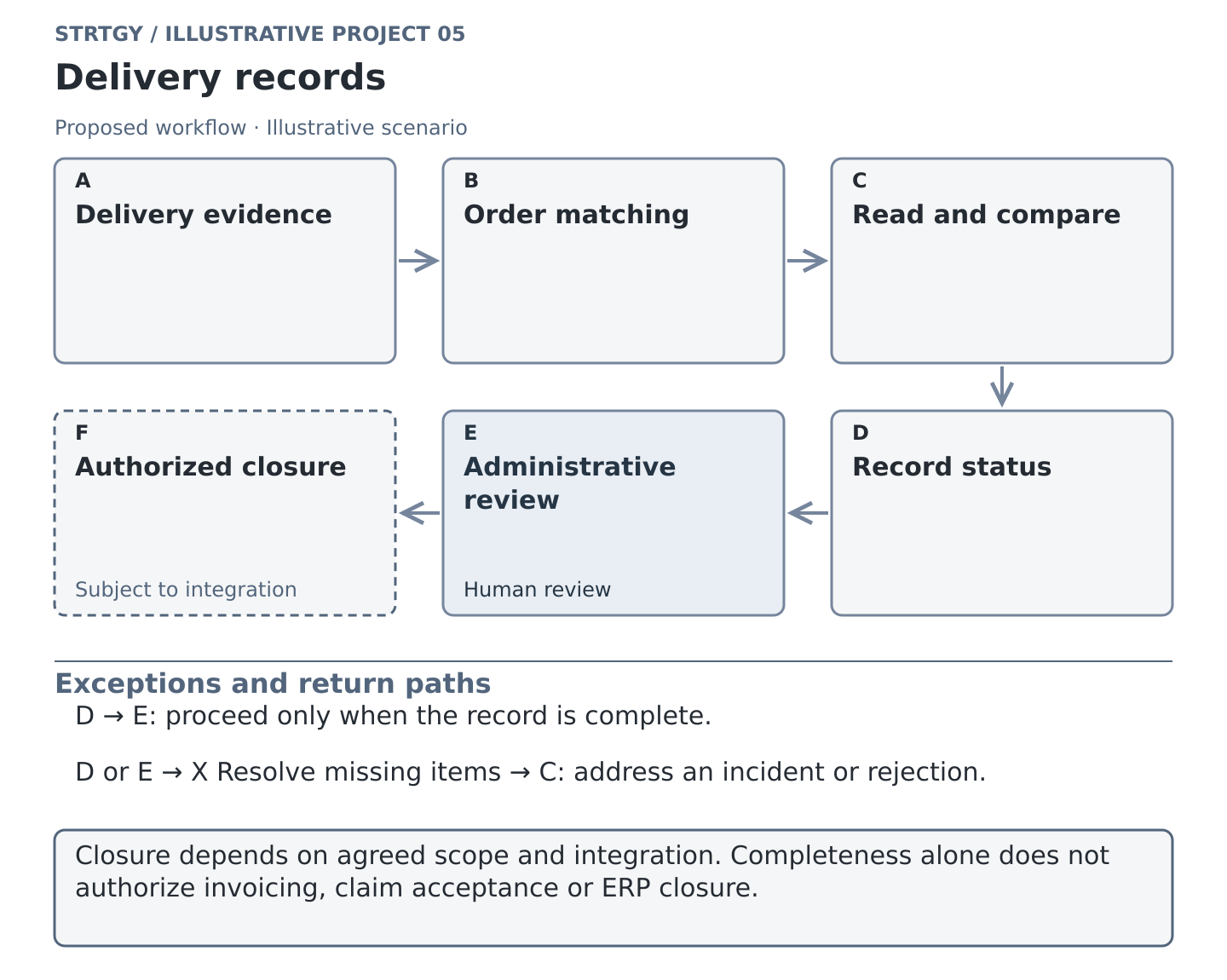
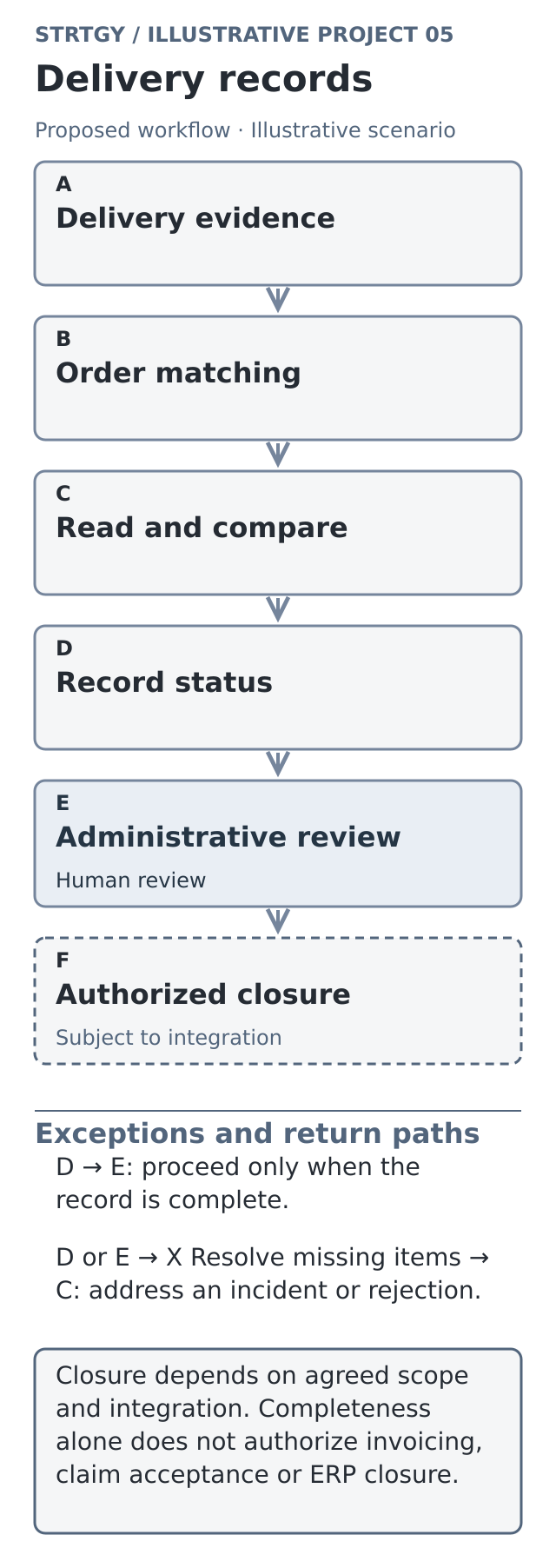
Receive. Every file is retained with its date, source, and identifier. Duplicates are detected without deleting original evidence.
Match. The workflow proposes an associated delivery using the reference number and authorized data. Ambiguous matches go to the coordinator.
Read. It extracts fields and evaluates legibility. If the image is insufficient, it shows the affected field rather than inventing its content.
Compare. Required documents, quantities, and references are checked against the order and the customer’s specific rules.
Classify. Complete records, missing documents, and operational incidents are separated. A partial delivery remains an exception.
Resolve. The responsible person validates the discrepancy or gathers new evidence. Requests to third parties are sent only through authorized channels and rules.
Approve. Administration reviews the record and logs its decision. If an integration exists, the status is updated with traceability and failure handling.
An inbox with the context to act
The user would see deliveries organized by age, customer, and type of outstanding issue. Opening one would show the requirements checklist, documents received, and the exact discrepancy blocking progress. Each extracted item would link to its original page or image. The record would retain who reviewed it, what they corrected, and the final decision.
Deliverables would include the document structure, customer-specific rules, extraction and validation logic, an exception inbox, and a review log. Testing would cover blurred images, split deliveries, duplicate files, and documents belonging to another order. Implementation would start with a customer or route with clear rules, then compare output with manually reviewed records. A supervised pilot would allow thresholds to be adjusted before adding channels or enabling status changes. Support and maintenance scope would be expressly agreed.

Illustrative image. Each record must retain its evidence and show which missing item or discrepancy prevents closure.
Measures that distinguish speed from quality
The baseline would be established by customer and delivery type, keeping incomplete records in the appropriate denominator:
First-review completeness: records meeting all requirements at their first review divided by records reviewed × 100.
Validation time: decision timestamp minus record-receipt timestamp, separating active work from time waiting for evidence.
Rework: records needing another review because of an internal error divided by records reviewed × 100.
False-complete rate: records marked complete that an audit finds incomplete divided by audited records marked complete × 100.
Acceptance criteria would include detecting critical missing items in the test set and preventing exceptions from being closed without an accountable person. No percentage would be promised before understanding the sources and their variability.
An operational capacity exercise
Assume 2,000 records per month and a hypothetical reduction in active work from eight to five minutes per record, including human review. The difference would be 2,000 × 3 ÷ 60 = 100 hours per month. At an assumed internal cost of 180 MXN per hour, that would represent 18,000 MXN per month in valued capacity. This is not payroll savings. It also does not demonstrate earlier collection of payment: invoicing, disputes, and payment terms depend on other factors. An investment case would need to account for processing, storage, integration, oversight, and implementation costs.
Which document is most often missing after a delivery? Let’s look at how to turn that gap into a visible, verifiable task.