INVENTORY AND PURCHASING
Español | English
Home · What We Do · Applications · Insights · Contact
Buy components with a clear view of demand, lead times, and constraints
Illustrative project
Illustrative scenario. The data and calculations are assumptions used to explain the application.
Application: Inventory and purchasing
Business type: Manufacturer of commercial display equipment
A purchasing decision that goes beyond price
The manufacturer uses common components across several product families. Planning manages production orders, purchasing handles supplier minimums and lead times, and the warehouse reports stock. When a sales order changes, the buyer tries to reconstruct manually which materials will actually be short and which are already on their way.
There are two risks: buying too much to meet a minimum order quantity, or receiving a low-cost component too late and holding up an assembly. The decision is which purchase requests need attention, in what quantity and by what date, and what information the buyer needs to discuss alternatives with the team.
The foundation for recommendations
The project would require current bills of materials, approved production orders, usable inventory, reservations, open orders, receipts, observed lead times, and supplier terms. Minimum quantities, pack multiples, and operating calendars would need to be defined. An unconfirmed sales plan would be treated as a scenario, separate from committed demand.
The solution would connect dependent demand, inventory, and supply to project shortages. It would apply explicit rules for coverage, lot sizes, and dates, presenting alternatives for review. If the ERP already provides materials planning, the project would seek to complement its data and exception management rather than assume it needs replacing.
Lead-time estimates would include their historical basis and variability. A prediction would not confirm a supplier’s delivery date. Accessing current inventory, preparing requisitions, or writing to the ERP would depend on authorized integrations. Sending orders and making purchase commitments would remain subject to the business’s approvals.
How a decision would be prepared
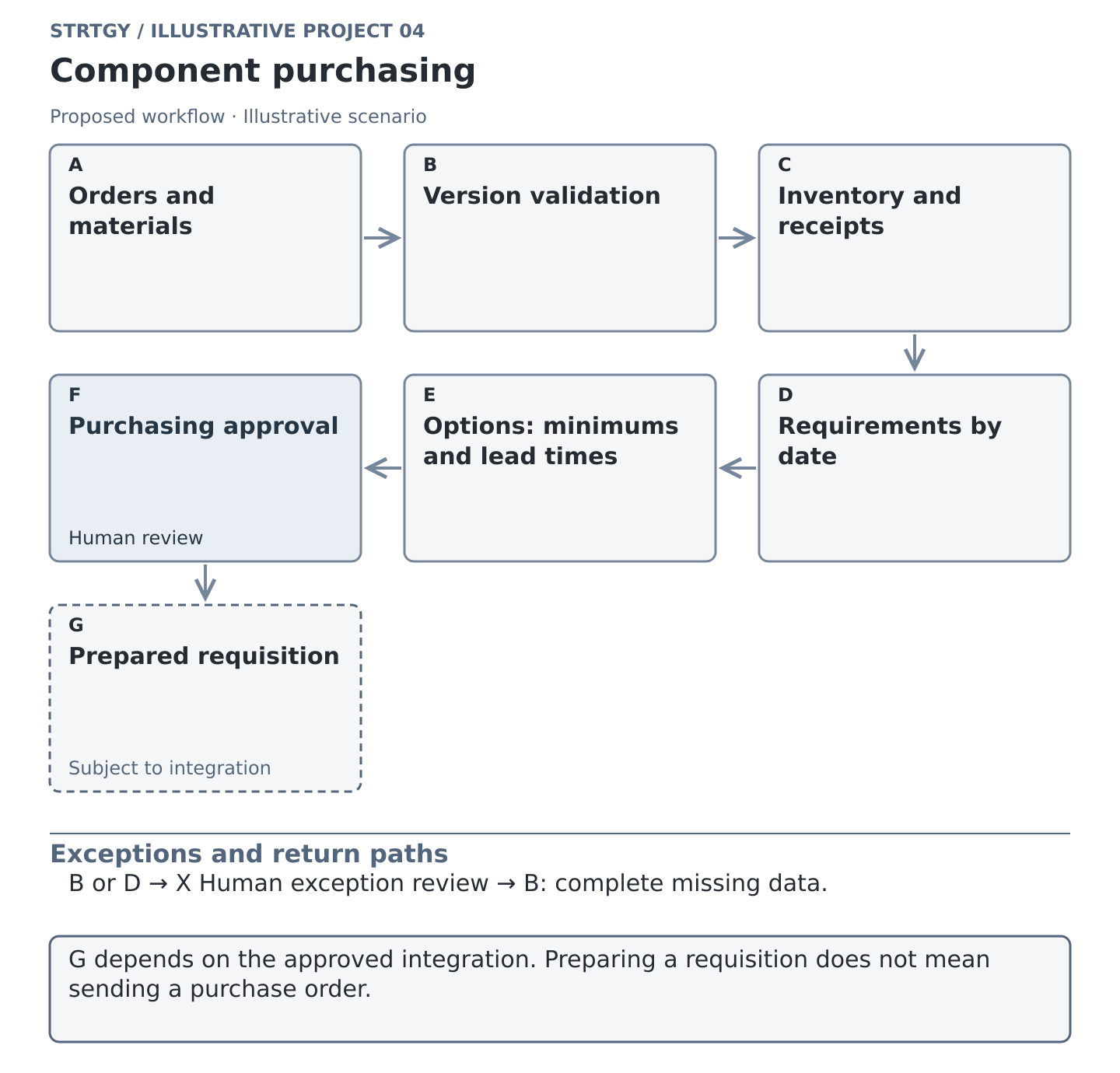
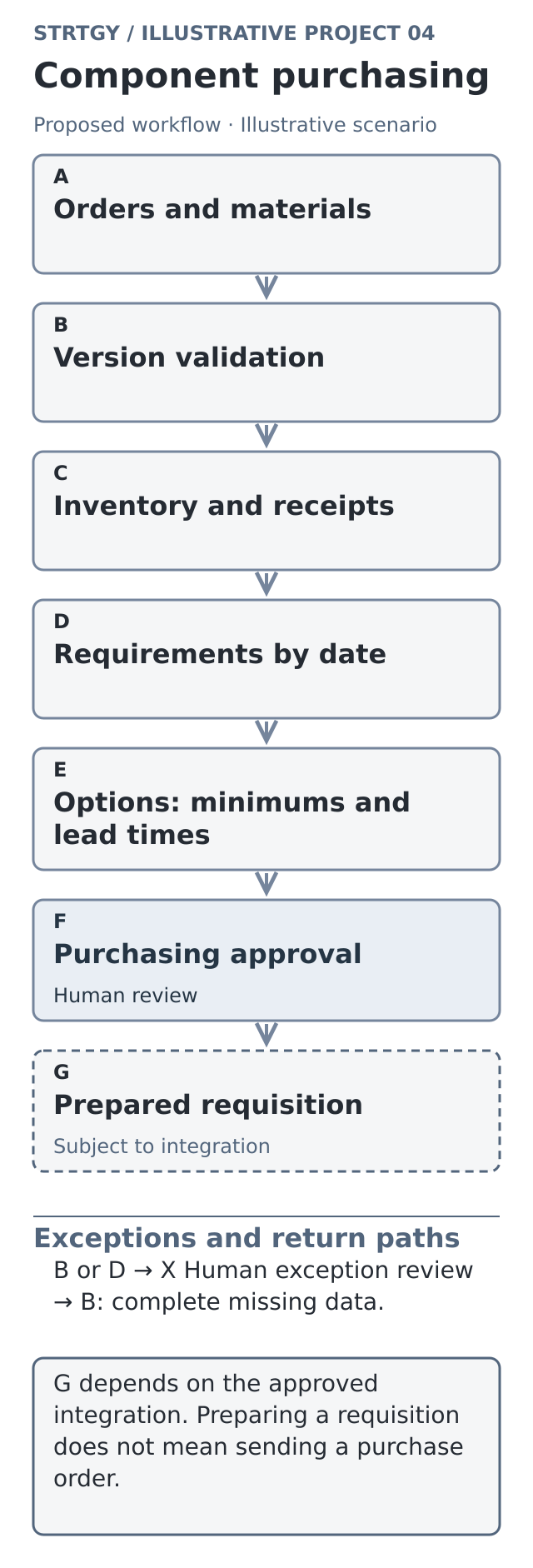
Validate. The workflow checks bill-of-materials versions and units. An item without an approved equivalent blocks the affected calculation.
Connect. Approved orders are converted into component requirements, with uncommitted scenarios kept separate.
Net requirements. Usable inventory and confirmed incoming supply are taken into account, avoiding duplicate orders where an open requisition already exists.
Project. Requirements are calculated by date, highlighting where uncertain lead times or potential delays change coverage.
Assess. The workflow compares quantities adjusted to minimums and pack sizes, permitted partial purchases, or rescheduling. Technical substitutions require specific approval.
Review. Purchasing and planning make evidence-based decisions. Changes to suppliers, spending, or terms follow the current approval matrix.
Record. The selected alternative and rationale are retained. If enabled, the integration prepares a requisition, and any failure is identified before a retry.
What the buyer would receive
An exception list would show the component, affected order, required date, supply considered, and the reason for the recommendation. The buyer could explore what changes if a supplier is late or planning reschedules an order. Options would retain their assumptions, avoiding false precision while a delivery remains unconfirmed.
Deliverables would include the requirements model, calculation rules, exception catalog, review view, and edge-case tests. Tests would cover duplicate orders, partial deliveries, version changes, and minimums that create excess stock. The project would begin with a stable product family, followed by reconciliation with planning, parallel operation without creating purchases, and a pilot with approvals. Transactional connections would follow validation of access, traceability, and error recovery. Expansion would depend on evidence, without committing to a timetable before assessment.

Measures that guard against misleading improvements
Baselines would be established before the pilot by product family and purchase type:
Urgent purchases: orders tagged as urgent under an agreed definition divided by purchase orders issued × 100.
Urgency-related extra cost: the sum of documented premium freight and price differences attributable to urgent purchases, without double-counting line items.
Component availability: requirements with all usable material available by the required date divided by requirements evaluated × 100.
Preparation effort: active minutes spent gathering information and preparing a purchasing decision.
Excess inventory and production-schedule changes would also be monitored. Reducing urgent purchases by buying disproportionate quantities would not be sufficient evidence of usefulness. Technical acceptance would require reproducing approved calculations and stopping cases where essential data is missing.
A value hypothesis with costs kept separate
Assume 20 urgent purchases per month, each with an average documentable extra cost of 1,500 MXN. The reference cost would be 20 × 1,500 = 30,000 MXN per month. If a pilot established that five urgent purchases were avoided through timely decisions, estimated gross benefit would be 5 × 1,500 = 7,500 MXN per month. This is a hypothesis, not a result or a demonstrated attribution. Additional inventory, system costs, and changes in supply would need to be deducted. Recovered sales or avoided production stoppages would not be included without specific evidence.
Which purchases become urgent even though the need was visible earlier? Let’s review how your demand connects with your supply decisions.